
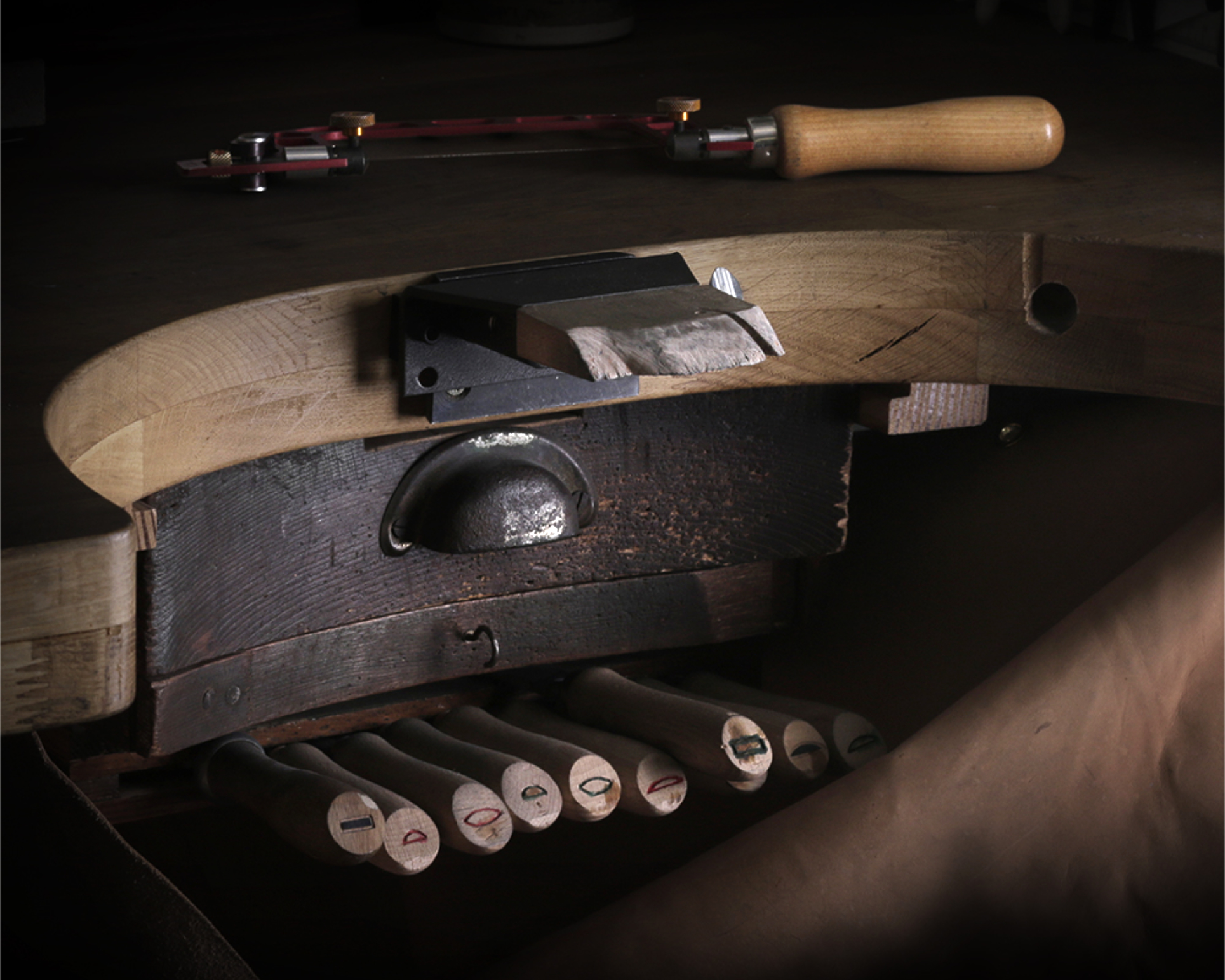
A casting machine gives you the shape, not the finish. Everything that makes a ring feel resolved in the hand — the even sweep of a polished shank, the click of a stone sitting exactly where it should — still happens the slow way, at the bench, with hand tools and a jeweller leaning into the light.
What “finishing” actually means
When a piece comes off the casting or out of the first build, it is rough. The surfaces carry the texture of the mould, the joins are visible, the edges are soft and slightly out of true. Finishing is the work of bringing that raw form up to the standard you actually wear: filing the lines true, drawing the surfaces flat, bringing each edge and curve to where it belongs.
We do it with the same tools jewellers have used for a century or more — needle files, emery sticks in descending grades, a polishing motor, and a great deal of patience. Each grade of emery removes the scratches left by the last, finer and finer, until the only thing left to do is bring up the shine. Skip a grade and you will see it forever, a faint cloudiness under the polish that no buffing will lift.
The checks you can only make by hand
Working a piece by hand means you are constantly feeling it. You run a thumb around the inside of a band to catch a sizing join before it is a problem. You rock a set stone gently to be sure of the setting. You hold the work to the window and turn it, because daylight finds things a bench lamp hides. They are the hundred small judgements that add up to a piece that lasts.
The pieces people keep for a lifetime were all finished by hand.
Setting stones the slow way
Stone setting is where hand work earns its keep. Each seat is cut to the individual stone, not a nominal size, so the girdle sits down evenly and the claws close with the same pressure all the way round. A well-set stone is held by metal that has been moved precisely, then burnished smooth so nothing snags. It should look effortless, which is exactly the part that takes the time.
Why we still bother
Because you can feel the difference, even if you could never name it. A hand-finished piece has edges that catch the light cleanly, a polish that goes right into the corners, and a weight in the hand that feels considered. Fifty years in, that is still the only way we are interested in working.