
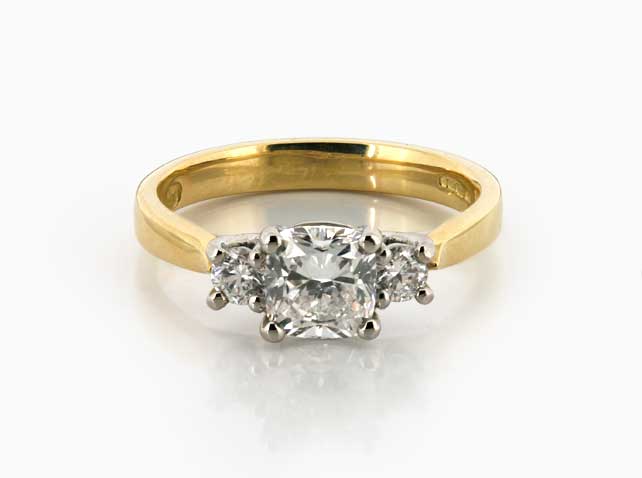
Before the modern round brilliant was worked out on paper, diamonds were cut by eye, by hand, and for candlelight. The cuts from those centuries have a softer, warmer way of returning light — broad flashes rather than the bright sparkle we are used to now. If you have inherited an old ring, or you are drawn to antique pieces, it helps to know what you are looking at.
Old-mine cut
The oldest you are likely to meet. Cushion-shaped with a squarish outline and gently rounded corners, a high crown, a small flat table and a large open culet — the little facet at the very bottom that, looked at face-on, shows as a dark dot in the centre. Cut by hand to follow the rough crystal, no two are quite alike. They were made to glow under flame, and they still do.
Old-European cut
The round forerunner of the modern brilliant, popular through the late 1800s and early 1900s. Like the old-mine it has a high crown, small table and open culet, but the outline is circular. Under modern lights it can look a touch lazy compared with a new stone; under softer, warmer light it has a depth and a roll of fire that a precision-cut diamond rarely matches.
A modern brilliant is cut to dazzle. An old cut is cut to glow.
Rose cut
Older still in origin, and quietly fashionable again. A rose cut has a flat base and a domed top of triangular facets rising to a point, like an opening rosebud — and no pavilion or culet at all. It does not sparkle so much as shimmer, with a soft, watery light. Because it sits low, it suits a hand that works.
Transitional cut
The bridge between the old-European and the modern brilliant, from roughly the 1920s and 30s, as cutting moved from the eye to the instrument. The culet shrinks, the table grows, the proportions tighten. A transitional stone keeps a little of the old warmth while edging toward modern brightness.
Living with an old stone
Old cuts reward an unhurried look. Their warmth, their tiny irregularities, the open culet winking in the centre — these are not faults to be corrected but the signature of a stone cut by a person. If you have one in a tired or unwearable setting, it can almost always be remounted: the same stone, the same history, in something you will actually wear. That is a conversation we have at the bench most weeks, and a happy one.